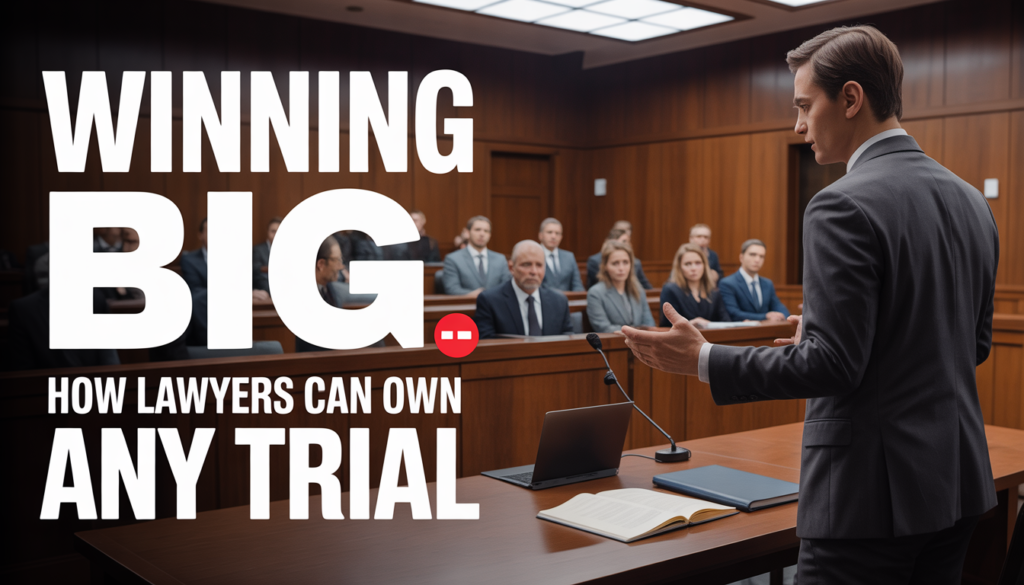
I have spent the better part of two decades walking into courtrooms, and if there is one thing I have learned, it is that a trial is not a search for the truth. That might sound cynical to a law student, but to those of us who live in the trenches, we know the reality: A trial is a contest of competing narratives. To “own” a trial isn’t about having the best facts; it’s about having the most unbreakable story and the psychological dominance to make the jury want to live inside it.
Winning big doesn’t happen during the closing argument. It happens in the months of grueling preparation, the strategic selection of the panel, and the subtle, relentless framing of the issues from the moment you say, “May it please the court.“
If you want to dominate the well of the courtroom, you have to stop thinking like a researcher and start thinking like a director, a psychologist, and a street fighter all at once. Here is my blueprint for how we, as trial lawyers, can take absolute ownership of any courtroom.
1. The “Theory of the Case” Is Your North Star:
Most lawyers lose because they try to argue everything. They throw twenty different defenses at the wall, hoping one will stick. All they end up doing is confusing the jury and looking desperate.
To own a trial, you must have a Singular Theory of the Case. This is a one-sentence “Moral Anchor” that explains not just what happened, but why it happened in a way that makes your client’s victory a requirement for justice.
Before I even file a motion in limine, I ask myself: “What is the ‘heart’ of this story?” * If I’m defending a corporation in a tort case, my theory isn’t “we weren’t negligent.” My theory is “This is a case about a plaintiff trying to monetize an unavoidable accident.”
If I’m prosecuting, it’s not “the defendant broke the law.” It’s “This is a case about a man who thought his convenience was more important than your safety.”
Every piece of evidence you introduce and every question you ask on cross-examination must serve that theory. If it doesn’t, it’s clutter. And clutter is the enemy of a winning verdict.
2. Winning During Voir Dire: The “Silent” Persuasion:
The biggest mistake I see young associates make is using Voir Dire to “sell” their case. They stand there and lecture the potential jurors about the burden of proof or the presumption of innocence. The jurors nod, they get bored, and you learn nothing.
I use Voir Dire to Expose the Bias. I don’t want “fair” jurors; I want jurors whose personal “Moral Code” aligns with my Theory of the Case. I ask open-ended, uncomfortable questions. I want to hear them talk. I want to know who is a leader, who is a follower, and who has a chip on their shoulder.
Ownership of the trial starts here because this is where you build the “Tribal Bond.” By the time the jury is sworn in, they shouldn’t just see me as “The Lawyer.” They should see me as the most honest, transparent person in the room. If you can get a juror to admit a prejudice to you during selection, you have already started winning.
3. The Opening Statement: Painting the Visual Reality:
The opening statement is not an “outline” of the evidence. It is a Virtual Reality Experience.
I never start with “The evidence will show…” That is weak language. I start with the “Action.” I want the jury to see, smell, and feel the scene. I use the “Power of the Present Tense.” “It is 2:00 AM. The rain is lashing against the windshield. My client, John, is focused on the road…”
By the time I sit down, the jury should have a mental movie playing in their heads. If my movie is more vivid and more logical than my opponent’s, the actual testimony that follows will just be “Special Effects” that confirm the movie they’ve already watched. You own the trial when the jury starts filtering the witness testimony through the lens you provided in the first twenty minutes.
4. Cross-Examination: The Art of the “Tight Leash.”
Cross-examination is where trials are won or lost, but not for the reasons people think. It’s not about the “Perry Mason” moment where the witness breaks down and cries. It’s about Total Control.
I never ask a question on cross-examination that I don’t already know the answer to. My questions are never “Questions”; they are “Statements” that the witness is forced to agree with.
- “You were there?”
- “It was dark?”
- “You weren’t wearing your glasses?”
If the witness tries to explain, I shut it down. “Thank you, Mr. Smith, a simple ‘Yes’ or ‘No’ will suffice.” Ownership of the courtroom means the witness is merely a prop in your performance. You are the one telling the story; they are just providing the punctuation. When you can lead a hostile witness down a path where they have no choice but to admit your “Mini-Truths,” the jury sees you as the ultimate authority in the room.
5. Controlling the “Atmospherics” of the Well:
The “Well”, the space between the bench and the counsel tables, is my stage. To own a trial, you must command that physical space.
I pay attention to the “Visual Cues.” I don’t hide behind a lectern. I move. I stand at a distance that creates “Command” without being “Aggressive.” I look the jurors in the eye. I watch the judge’s clerk. I watch the court reporter.
But most importantly, I watch the Opposing Counsel. I never let them see me sweat. If they hit me with a surprise ruling or a damaging witness, I remain a stone. If the jury sees the lawyer look worried, they get worried. If you remain calm and seemingly “In Control” of every disaster, the jury assumes you have an ace up your sleeve, even when you don’t.
6. The Closing: Closing the “Circle of Logic.”
By the time I get to the closing argument, I am not trying to “Persuade” anymore. I am giving my “Friends” on the jury the Tools to fight for me in the deliberation room.
I know that the jury is going to go back there and argue. I need to give the three or four jurors who are “On My Side” the specific phrases, the specific exhibit numbers, and the specific logical “Gotchas” they need to convince the holdouts. “When you go back there, and someone says ‘What about X?’, I want you to look at Exhibit 14. Exhibit 14 tells you everything you need to know…”
You own the trial when you become the “Thirteenth Juror.” You are the one helping them solve the puzzle. You aren’t “Selling”; you are “Guiding.”
Conclusion:
Winning big in a trial requires a level of preparation that most people find exhausting. It requires knowing the “Rules of Evidence” so well that your objections are instinctive. It requires knowing your client’s “Warts” and being the one to expose them before the other side can.
But above all, owning a trial requires Belief. If you don’t believe in your Theory of the Case with every fiber of your being, the jury will smell it on you like cheap cologne. You have to be the “Moral Center” of that courtroom. When you step into that room, it is your house. The judge is the host, the jury is the guest, but you are the one running the show.
That is how you win. That is how you own the trial.
FAQs:
1. What do I do if a witness goes “Off Script”?
Immediately pivot to your “Impeachment” materials—use their deposition to box them back into their original statement.
2. How do I handle a “Hot” judge who keeps sustaining objections?
Stay respectful, make your “Offer of Proof” for the record, and don’t let the jury see you get frustrated.
3. Is it okay to use “High-Tech” exhibits?
Only if they work perfectly; a technical glitch in the middle of a climax is a “Trial-Killer” that makes you look unprepared.
4. What is the “Rule of Three” in trials?
Juries tend to remember things in threes—three key facts, three key witnesses, or three key words in your theme.
5. How do I deal with a “Smoking Gun” document?
Address it head-on in your opening; “De-claw” the evidence by explaining its context before the other side can use it to shock the jury.
6. When should I waive my opening statement?
Almost never; the opening is your first and best chance to “Prime” the jury’s brain for your version of the facts.
